Patient Generated Health Data Implementation Guide - Local Development build (v0.1.0) built by the FHIR (HL7® FHIR® Standard) Build Tools. See the Directory of published versions
Home
| Official URL: https://pghd.na.icar.cnr.it/ImplementationGuide/pghd | Version: 0.1.0 | |||
| Active as of 2026-03-30 | Computable Name: PGHD | |||
Scope
This Implementation Guide (IG) defines a structured and interoperable framework of HL7 FHIR R4 profiles, extensions, value sets, and example instances to support the collection, representation, validation, and controlled sharing of Patient-Generated Health Data (PGHD) within a consent-aware digital health ecosystem.
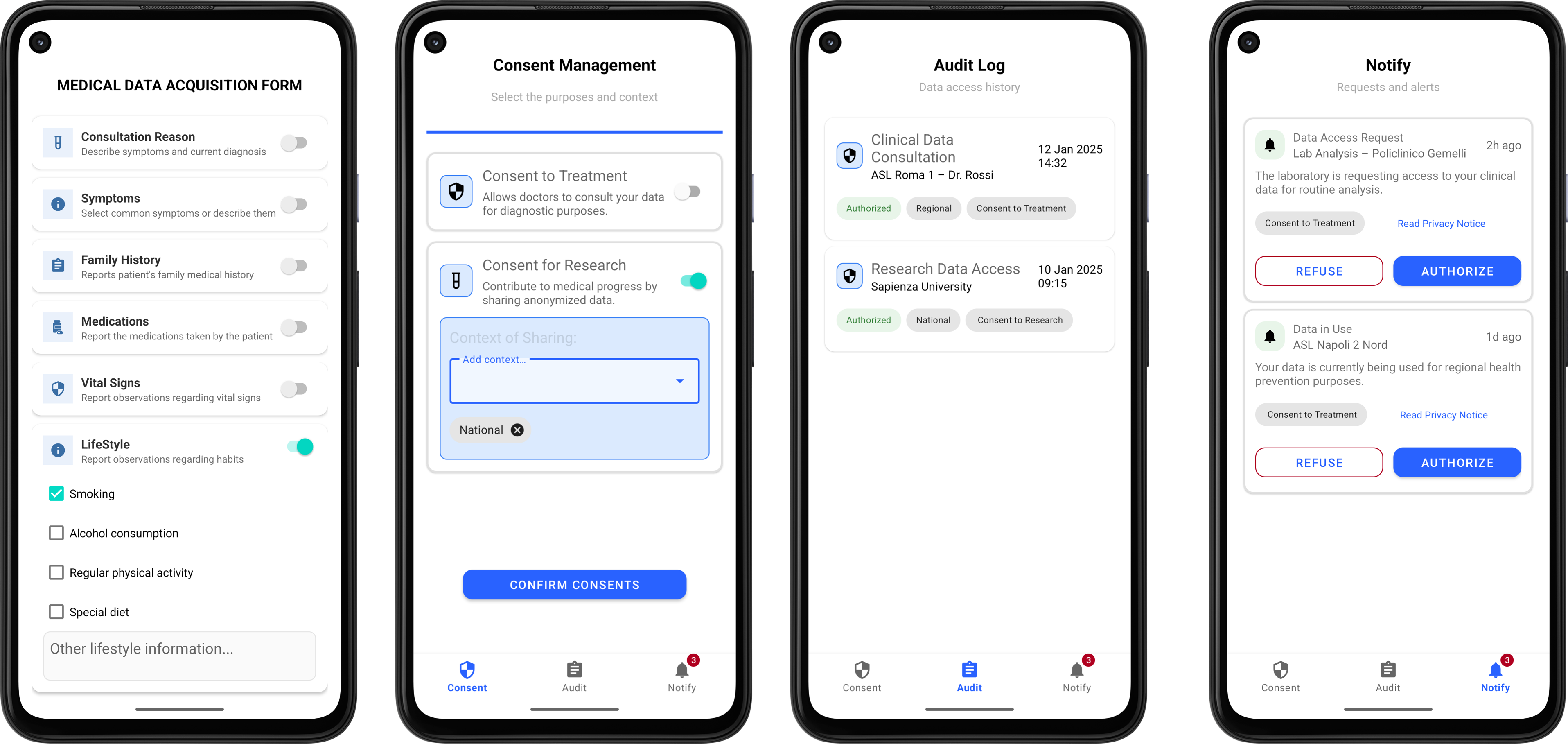
The IG is designed for scenarios in which patients are already associated with a predefined clinical risk assessment generated by an external system and are subsequently asked to provide additional health-related information through a mobile application. Such information includes demographic data, personal medical history, family history, lifestyle-related factors, and other clinically relevant observations that may contribute to more accurate risk contextualization, personalized care pathways, and secondary use for research purposes.
A central objective of this IG is the standardized management of informed consent through the HL7 FHIR Consent resource. In particular, the IG introduces a structured model for representing granular patient authorization preferences, allowing patients to explicitly distinguish between different purposes of data use—such as treatment and research—and to define the organizational contexts in which access is permitted. This enables fine-grained and dynamically manageable authorization policies, ensuring that every access to patient data is evaluated against the patient’s current consent status.
From a technical perspective, the IG serves as a semantic and operational blueprint for interoperable solutions that exchange data through FHIR-compliant RESTful APIs. It supports the validation, persistence, and retrieval of consent-aware health information within a dedicated FHIR server infrastructure, enabling both primary clinical use and ethically governed secondary use of data.
Dependence
| IG | Package | FHIR | Comment |
|---|---|---|---|
  Patient Generated Health Data Implementation Guide Patient Generated Health Data Implementation Guide | pghd#0.1.0 | R4 | |
 HL7 Terminology (THO) HL7 Terminology (THO) | hl7.terminology.r4#7.1.0 | R4 | Automatically added as a dependency - all IGs depend on HL7 Terminology |
  FHIR Extensions Pack FHIR Extensions Pack | hl7.fhir.uv.extensions.r4#5.2.0 | R4 | |
 FHIR Tooling Extensions IG FHIR Tooling Extensions IG | hl7.fhir.uv.tools.r4#0.9.0 | R4 | for example references |
Package hl7.fhir.uv.extensions.r4#5.2.0 This IG defines the global extensions - the ones defined for everyone. These extensions are always in scope wherever FHIR is being used (built Mon, Feb 10, 2025 21:45+1100+11:00) |
Package hl7.fhir.uv.tools.r4#0.9.0 This IG defines the extensions that the tools use internally. Some of these extensions are content that are being evaluated for elevation into the main spec, and others are tooling concerns (built Tue, Dec 16, 2025 23:18+1100+11:00) |
Details
Cross-Version Analysis
This is an R4 IG. None of the features it uses are changed in R4B, so it can be used as is with R4B systems. Packages for both R4 (pghd.r4) and R4B (pghd.r4b) are available.
Implementation Guide
This is a Beta Implementation Guide for collecting patient medical history data and managing consent.

Authors and contributors
| Role | Name | Organization | |
|---|---|---|---|
| Author | Teresa Conte | ICAR-CNR | teresa.conte@icar.cnr.it |
| Mario Sicuranza | ICAR-CNR | mario.sicuranza@icar.cnr.it | |
| Contributor |
Intellectual Property Statements
This publication includes IP covered under the following statements.
- These codes are excerpted from Digital Imaging and Communications in Medicine (DICOM) Standard, Part 16: Content Mapping Resource, Copyright © 2011 by the National Electrical Manufacturers Association.Show Usage
- This material contains content that is copyright of SNOMED International. Implementers of these specifications must have the appropriate SNOMED CT Affiliate license - for more information contact https://www.snomed.org/get-snomed or info@snomed.org.Show Usage
- This material derives from the HL7 Terminology (THO). THO is copyright ©1989+ Health Level Seven International and is made available under the CC0 designation. For more licensing information see: https://terminology.hl7.org/license.htmlShow Usage